
Behaviour and Anti-Bullying
Building Positive Relationships, Creating a Sense of Belonging and Helping Every Child Flourish
At Winford Church of England Primary School, we believe that every child deserves to feel safe, valued, respected and included.
Our Christian vision, Together we Flourish, and our school values of Aspire, Belong and Care underpin our approach to behaviour and relationships.
We have high expectations for behaviour because we want every child to learn in a calm, supportive environment where they feel confident, develop positive relationships and can achieve their best.
As a nurturing school, we recognise that behaviour is something children learn and develop. We explicitly teach positive behaviour, model respectful relationships and support children to understand and manage their emotions.
Our approach combines clear expectations, consistent boundaries, positive relationships and appropriate support.
Our Three School Rules
We have three simple rules that are understood and followed throughout the school.
Ready • Respectful • Safe
Be Ready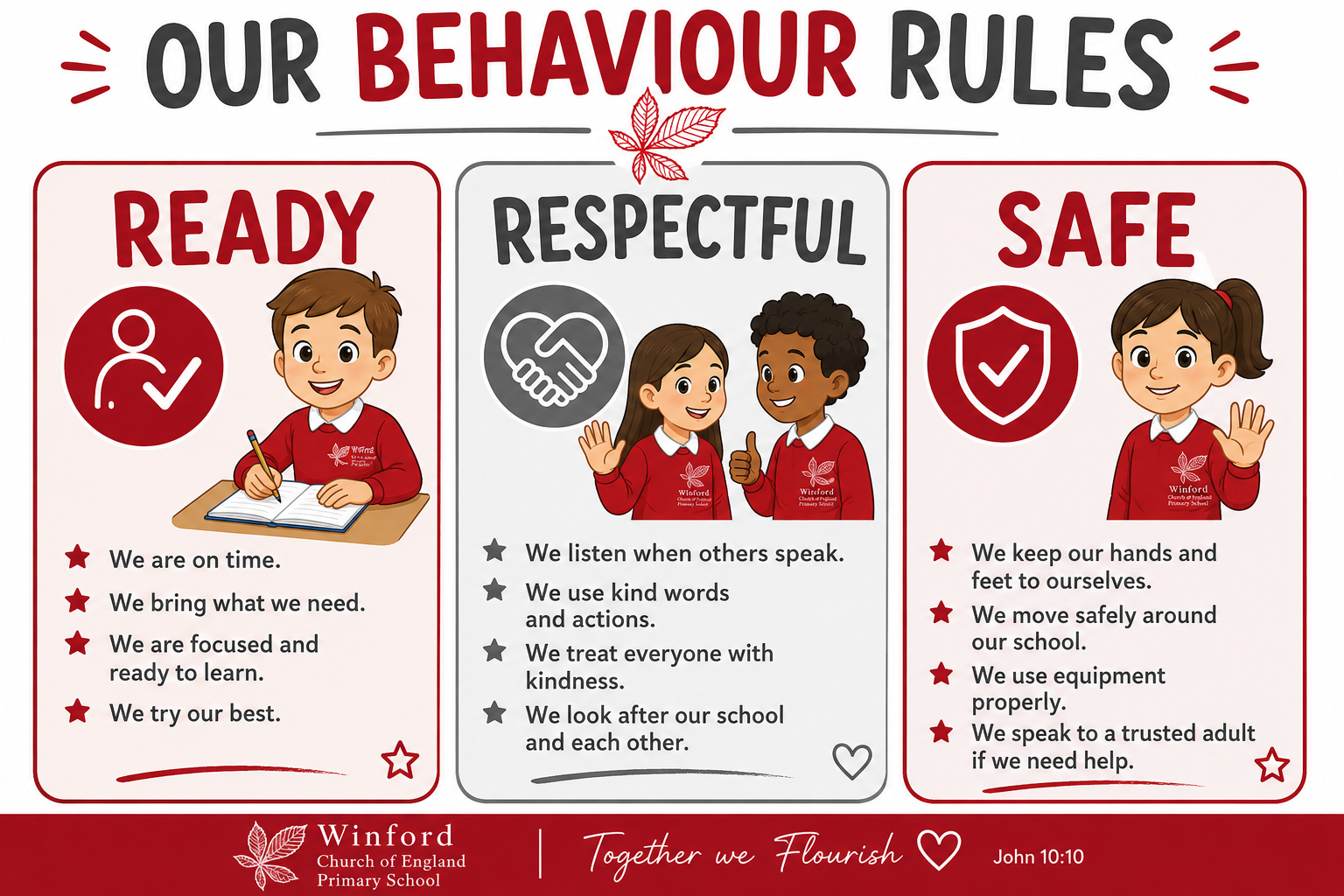
We are ready to learn, listen and participate.
This means arriving prepared, following instructions, showing good learning behaviours and trying our best, even when something is challenging.
Be Respectful
We treat everyone with kindness, consideration and respect.
This means listening to others, using kind words, respecting differences, looking after our school and recognising how our actions affect other people.
Be Safe
We make choices that help keep ourselves and others safe.
This means moving safely around school, using equipment responsibly, respecting personal boundaries and telling a trusted adult when something is wrong.
These expectations apply in classrooms, around the school, at playtimes, during educational visits and in our interactions online.
Teaching Positive Behaviour
Behaviour Is Taught, Modelled and Practised
We do not assume that children automatically know how to behave in every situation.
Instead, we explicitly teach the routines, expectations and social skills that help children succeed.
Our staff use consistent language and approaches so that children understand what is expected, regardless of which adult is supporting them.
This includes teaching children how to:
-
Listen actively and participate in learning.
-
Work cooperatively with others.
-
Move safely and calmly around school.
-
Manage disagreements appropriately.
-
Recognise and communicate their feelings.
-
Take responsibility for their actions.
-
Show kindness, respect and consideration.
-
Seek help when they need it.
Our behaviour curriculum (Learning Gems) includes a focus on positive learning behaviours and respectful interactions, helping children develop the skills they need to become successful learners and responsible members of our community.
Relationships at the Heart of Behaviour
Connection Before Correction
We believe that positive relationships are the foundation of good behaviour.
Our staff take time to get to know children, understand their individual needs and build relationships based on trust, care and mutual respect.
We recognise that all behaviour is communication. When a child struggles with their behaviour, we aim to understand what may be contributing to the difficulty while maintaining clear and consistent expectations.
Understanding the reasons behind behaviour does not mean accepting behaviour that is unsafe or unkind. It helps us respond effectively and teach children how to make better choices.
Our approach reflects the principles of nurture, recognising the importance of emotional wellbeing, relationships, safety and belonging.
Recognising and Celebrating Positive Behaviour
We believe that noticing and celebrating positive behaviour helps children develop confidence and encourages them to make good choices.
Positive behaviour is recognised through:
-
Verbal praise and encouragement.
-
House points and stickers.
-
Recognition of effort, kindness and perseverance.
-
Celebration Worship and special awards.
-
Positive communication with parents and carers.
-
Opportunities to celebrate individual and collective achievements.
We particularly value children who demonstrate positive learning attitudes, show care for others, persevere through challenges and contribute positively to school life.
Our emphasis is on recognising genuine effort, improvement and positive choices.
When Behaviour Falls Below Expectations
Children sometimes make mistakes, experience difficulties or need additional support to meet our expectations.
When this happens, staff respond calmly, fairly and consistently.
Our approach includes:
-
Reminding and redirecting – Helping the child understand the expected behaviour and make a positive choice.
-
Providing clear warnings and support – Explaining expectations and giving opportunities to improve.
-
Reflection and appropriate consequences – Supporting the child to understand the impact of their behaviour.
-
Restoration and a fresh start – Helping children repair relationships, learn from the experience and move forward.
Consequences are proportionate to the behaviour and take account of the child's age, development and individual needs.
More serious incidents, including aggression, discriminatory behaviour or bullying, are escalated to senior leaders and responded to appropriately.
We work closely with families when behaviour concerns arise and aim to identify practical ways to support improvement.
Our full Belonging and Behaviour Policy explains our behaviour procedures in greater detail.
Supporting Emotional Regulation
We recognise that children need to learn how to identify, understand and manage their emotions.
At Winford, we use the Zones of Regulation to help children recognise how they are feeling and develop strategies to manage different emotions.
Children are encouraged to:
-
Recognise and name their feelings.
-
Understand how emotions can influence behaviour.
-
Identify strategies that help them feel calm and ready to learn.
-
Ask adults for support when needed.
-
Reflect on situations and develop positive coping strategies.
Classrooms have calm or reflection spaces, and additional nurturing environments, including The Nurture Room, The Snug and The Ark, are available for children who need further support.
Our aim is to help children develop emotional awareness, resilience and independence over time.
Our Commitment to Preventing Bullying
Everyone Has the Right to Feel Safe and Belong
At Winford, bullying is not tolerated.
We are committed to creating a school community where children feel safe, accepted and confident that adults will listen and take action if they have a concern.
We recognise that preventing bullying requires more than responding to incidents. It involves deliberately teaching positive relationships, celebrating difference, challenging unkind behaviour and developing a culture in which everyone feels that they belong.
What Is Bullying?
Bullying is behaviour by an individual or group, repeated over time, that intentionally hurts another person physically or emotionally.
Bullying can take different forms, including:
-
Physical bullying: Hitting, pushing, kicking or deliberately hurting someone.
-
Verbal bullying: Repeated name-calling, insults, threats or hurtful comments.
-
Social or relational bullying: Deliberately excluding someone, spreading rumours or damaging friendships.
-
Online bullying: Repeated hurtful or threatening behaviour through digital communication.
Bullying may also involve prejudice or discrimination relating to characteristics such as race, religion, disability, sex or other differences.
We challenge discriminatory language and behaviour and take all concerns seriously.
Bullying and Friendship Difficulties
Children sometimes disagree, fall out with friends or say things that upset others.
These situations are not always bullying, but they still matter and may require adult support.
We help children understand the difference between an isolated disagreement and repeated, intentional hurtful behaviour.
We also recognise that repeated incidents can develop into a pattern of bullying if they are not addressed.
Children do not have to decide whether something counts as bullying before asking for help. If something is making them unhappy, worried or unsafe, we want them to tell an adult.
How We Prevent Bullying
Our anti-bullying work is woven throughout everyday school life.
Teaching Respect and Positive Relationships
Through our Jigsaw PSHE curriculum, children learn about friendships, healthy relationships, differences, respect, personal boundaries and how to seek help.
We teach children to recognise unkind behaviour, understand its impact and develop the skills to build positive relationships.
Worship, Values and School Culture
Our school values of Aspire, Belong and Care are regularly explored through collective worship, classroom discussions and everyday interactions.
We encourage children to demonstrate kindness, compassion, fairness and respect.
Anti-Bullying Week
We participate in Anti-Bullying Week to reinforce important messages about kindness, inclusion, speaking up and seeking help.
However, our work to prevent bullying continues throughout the year.
Online Safety
Children learn about respectful online behaviour, recognising online bullying and what to do if something makes them uncomfortable or unsafe.
Online safety is taught through our Computing curriculum and wider safeguarding education.
Positive Playtimes and Friendships
We recognise that playtimes and lunchtimes are important opportunities for children to develop social skills and friendships.
Adults supervise these times, support children to resolve difficulties and help them participate positively in play.
Our wider provision, including structured activities and lunchtime support, provides additional opportunities for children who find social situations challenging.
What Happens If Bullying Is Reported?
We take all reports of bullying seriously.
When a concern is raised, staff will:
-
Listen carefully to the child or adult reporting the concern.
-
Investigate what has happened, speaking to those involved as appropriate.
-
Record and review incidents to identify patterns or repeated behaviour.
-
Take appropriate action to stop the behaviour and keep children safe.
-
Support the children involved, including those who have experienced bullying.
-
Work with parents and carers and monitor the situation to ensure that action has been effective.
Responses may include appropriate consequences, targeted support, increased supervision, individual behaviour plans and restorative work where suitable.
We recognise that restorative conversations must be appropriate to the situation and should never place pressure on a child who has experienced bullying.
Our priority is to ensure that harmful behaviour stops, children feel safe and positive relationships can be developed.
Helping Children Speak Up
We want every child at Winford to know that they can speak to an adult if something is worrying them.
Children are encouraged to talk to their class teacher, a Learning Partner or another trusted adult.
We regularly reinforce the importance of telling someone if they:
-
Feel frightened, excluded or repeatedly upset by another child.
-
See someone else being treated unkindly.
-
Experience hurtful comments or behaviour online.
-
Feel unsafe or uncomfortable.
-
Are worried about a friendship or relationship.
We encourage children to speak up for themselves and others, knowing that their concerns will be taken seriously.
No child should feel that they have to manage bullying alone.
Supporting Children with Additional Needs
We recognise that some children may need additional support to understand social situations, manage emotions or develop positive behaviour.
Our approach is inclusive and takes account of children's individual needs, including SEND, communication difficulties and social or emotional development.
Support may include:
-
Individual behaviour or pastoral support plans.
-
Additional emotional regulation work.
-
Targeted social skills interventions.
-
Support from Learning Partners.
-
Nurture-based provision.
-
Assessment using tools such as the Boxall Profile.
-
Working with families and external professionals where appropriate.
We use a graduated approach to identify needs, provide support and review progress.
Our aim is to help children develop the skills they need to participate successfully in school life while ensuring that everyone remains safe and respected.
Working in Partnership with Parents
We believe that strong relationships between home and school are essential in supporting positive behaviour and preventing bullying.
If you have a concern about your child's behaviour, friendships or experiences at school, we encourage you to speak to their class teacher in the first instance.
If the concern is serious, ongoing or remains unresolved, you can contact a member of the Senior Leadership Team.
When sharing concerns, it is helpful to provide as much information as possible about what has happened, including any relevant dates or incidents.
We will listen, investigate appropriately and work with you to identify the next steps.
To protect children's privacy, we cannot share confidential information about other pupils or any individual consequences they may receive.
Our shared priority is ensuring that every child feels safe, supported and able to flourish.
Our Policies and Further Information
For full details of our expectations, procedures and approaches, please see:
-
Belonging and Behaviour Policy, Anti-Bullying Policy, Safeguarding and Child Protection Policy on our policies page
If you would like to discuss a concern, please contact the school office on 01275 472730 or email office@winfordprimary.com.
Together we Flourish
Aspire • Belong • Care
Every child deserves to feel safe, respected, included and ready to learn.