
Maths
Mathematics Curriculum
Maths Is for Everyone – Building Confidence, Understanding and a Love of Learning
At Winford Church of England Primary School, we believe that maths is for everyone. Every child can succeed in mathematics when they are given the right support, encouragement and opportunities to develop a deep understanding.
Our aim is for all children to become confident, curious and capable mathematicians who enjoy solving problems, recognise patterns and understand how mathematics is used in everyday life.
Our Christian vision, Together we Flourish, and our school values of Aspire, Belong and Care are reflected in our approach. We have high expectations for every child, celebrate effort and perseverance, and ensure that all learners feel included and supported.
Our Mathematics Curriculum
At Winford, we use White Rose Maths to support the planning and teaching of mathematics from Reception to Year 6.
White Rose Maths provides a carefully sequenced, mastery-based approach that helps children develop secure mathematical knowledge and understanding.
Our curriculum is designed around the belief that children need strong mathematical foundations before they can confidently tackle more complex ideas.
We often compare learning mathematics to building a tower. Each new concept is a building block that relies on secure understanding of what has come before. If important blocks are missing, the tower becomes unstable.
By teaching in carefully structured steps, revisiting important concepts and checking understanding, we help children build strong mathematical foundations that will support them throughout their education.
We want children to understand not just how to complete a calculation, but why mathematical methods work.
Teaching for Mastery
Developing Deep and Lasting Mathematical Understanding
Our approach to mathematics is based on the principles of teaching for mastery.
This means that we focus on developing secure understanding, rather than moving children rapidly through new content.
We want children to become fluent in important mathematical facts, reason confidently and apply their learning to different problems.
Small Steps in Learning
White Rose Maths breaks mathematical concepts into carefully sequenced small steps.
Each step builds on previous learning, helping children develop understanding gradually and make connections between mathematical ideas.
Teachers use assessment and questioning to identify misconceptions and provide additional support or challenge.
Concrete, Pictorial and Abstract Learning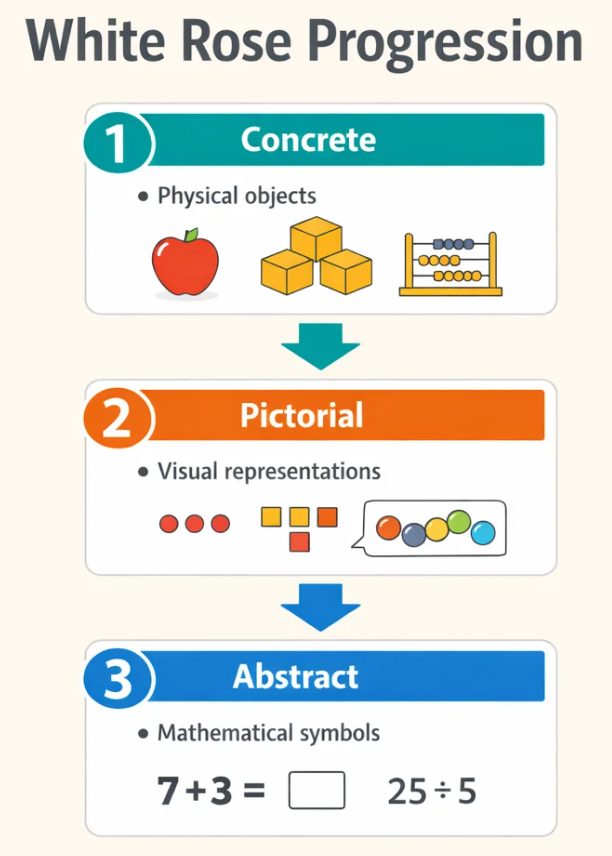
Children are supported in developing mathematical understanding through different representations.
Concrete: Using practical equipment such as counters, cubes, tens frames, number lines and place value resources.
Pictorial: Using diagrams, pictures and models, including bar models and part-whole representations.
Abstract: Using numbers, symbols and written calculations.
Children learn to make connections between these representations, developing an understanding of the mathematics behind the methods they use.
Practical equipment and visual models remain valuable throughout primary school, not just for younger children.
Mathematical Talk and Reasoning
We encourage children to explain their thinking, discuss different strategies and justify their answers.
Children learn to use mathematical vocabulary accurately and develop confidence in explaining how they know something is true.
Teachers use questioning and discussion to help children make connections and deepen their understanding.
Challenge Through Greater Depth
Children who demonstrate secure understanding are challenged to explore mathematical ideas in greater depth.
Rather than simply moving on to the next year's content, they are encouraged to investigate patterns, explain relationships, solve more complex problems and apply their learning in unfamiliar situations.
This ensures that all children experience appropriate challenge while developing strong foundations.
The Three Aims of the Mathematics National Curriculum
Our curriculum develops the three interconnected aims of the National Curriculum for Mathematics.
1. Fluency
Becoming Confident and Efficient with Mathematics
Children develop secure knowledge of number facts, mathematical relationships and calculation methods.
They learn to recall important facts accurately and use efficient strategies.
Fluency enables children to focus on more complex mathematical thinking without becoming overwhelmed by basic calculations.
2. Mathematical Reasoning
Explaining and Justifying Mathematical Thinking
Children learn to recognise patterns, make connections and explain why mathematical statements are true.
They are encouraged to use mathematical vocabulary, provide evidence and consider different approaches.
Reasoning helps children develop deeper understanding and confidence.
3. Problem-Solving
Applying Mathematics to New Situations
Children learn to apply their mathematical knowledge to a range of problems, including unfamiliar and real-life situations.
They develop strategies for identifying relevant information, selecting appropriate methods and checking whether their answers are reasonable.
We encourage children to persevere, explore different approaches and learn from mistakes.
Mathematics in Reception
In Reception, children develop the foundations of mathematical understanding through the Early Years Foundation Stage.
White Rose Maths supports our approach to early mathematical learning, with a strong emphasis on number sense, patterns and practical exploration.
Children develop their understanding through stories, songs, games, practical activities and play.
Learning includes:
-
Counting and recognising numbers.
-
Understanding the composition of numbers.
-
Subitising – recognising small quantities without counting.
-
Comparing quantities.
-
Exploring number bonds and relationships.
-
Recognising and continuing patterns.
-
Exploring shapes and spatial relationships.
-
Developing mathematical language.
We aim to ensure that children develop a deep understanding of early number concepts and positive attitudes towards mathematics.
Mathematics in Key Stage 1
In Years 1 and 2, children build on their early mathematical experiences and develop increasing confidence with number and calculation.
Through White Rose Maths, learning is organised into carefully sequenced blocks.
Children explore:
-
Number and place value.
-
Addition and subtraction.
-
Multiplication and division.
-
Fractions.
-
Measurement, including money and time.
-
Geometry, including shape, position and direction.
-
Mathematical reasoning and problem-solving.
Practical resources, visual models and discussion help children understand mathematical concepts and make connections.
We place particular importance on developing secure number facts and efficient calculation strategies.
Mathematics in Key Stage 2
In Years 3 to 6, children deepen their mathematical understanding and apply their knowledge to increasingly complex problems.
Learning includes:
-
Number and place value: Understanding increasingly large numbers and the relationships between them.
-
Addition, subtraction, multiplication and division: Developing efficient mental and written calculation methods.
-
Fractions, decimals and percentages: Understanding relationships between different representations of number.
-
Measurement: Exploring length, mass, capacity, time, money, area, perimeter and volume.
-
Geometry: Investigating shapes, angles, position and direction.
-
Statistics: Collecting, presenting and interpreting data.
-
Ratio and proportion: Developing proportional reasoning in Years 5 and 6.
-
Algebra: Exploring mathematical relationships and using symbols in Year 6.
Throughout Key Stage 2, children are encouraged to reason, explain their methods and apply their knowledge in different contexts.
Our aim is for children to leave Winford with secure mathematical foundations and the confidence needed for secondary school.
Developing Fluency and Number Sense
A strong understanding of number is essential for success in mathematics.
We place particular importance on helping children develop fluency with number facts, including number bonds, multiplication tables and related division facts.
Children are supported in understanding how numbers relate to one another, rather than relying solely on memorisation.
Regular opportunities to practise and revisit important facts help children develop confidence and automaticity.
As children become more fluent, they can apply their knowledge more efficiently to calculations, reasoning and problem-solving.
Calculation Methods at Winford
We believe that children need to understand how and why calculation methods work.
Our calculation policies set out the progression of methods used to teach the four operations:
-
Addition.
-
Subtraction.
-
Multiplication.
-
Division.
These methods are supported by the concrete, pictorial and abstract approach, helping children move from practical understanding towards efficient written calculations.
Our policies provide a consistent approach across the school and useful guidance for parents supporting mathematics at home.
You can download our calculation policies at the bottom of this page.
Mathematics in Everyday Life
We want children to recognise that mathematics is an important part of the world around them.
Mathematical skills are used in many everyday situations, including:
-
Shopping, handling money and calculating change.
-
Cooking and measuring ingredients.
-
Telling the time and understanding timetables.
-
Measuring distances, lengths and quantities.
-
Reading charts, graphs and tables.
-
Recognising shapes and patterns.
-
Planning journeys and understanding directions.
-
Solving practical problems.
Our wider curriculum provides opportunities to apply mathematical knowledge in subjects such as Science, Geography, Design and Technology, and Computing.
Practical activities, including gardening and cooking, also help children see how mathematics connects to real-life experiences.
Helping Children Know More and Remember More
Our mathematics curriculum is carefully sequenced through White Rose Maths to help children develop secure knowledge and understanding over time.
Important concepts are revisited and developed, allowing children to make connections between previous and new learning.
Teachers use questioning, discussion, practical activities and assessment to check understanding and identify misconceptions.
Where children have gaps in their understanding, we aim to address these promptly so that they can continue to build on secure foundations.
We recognise that children may need additional practice, different representations or further explanation to fully understand a concept.
Our focus is on developing lasting mathematical understanding rather than simply completing tasks.
Supporting Every Learner
We believe that every child can make progress in mathematics.
Teachers adapt learning to meet individual needs while maintaining high expectations for all pupils.
This may include:
-
Practical equipment and visual representations.
-
Carefully structured tasks and explanations.
-
Additional modelling and guided practice.
-
Opportunities to revisit and consolidate learning.
-
Targeted support to address gaps in understanding.
-
Reasoning and problem-solving challenges to deepen understanding.
We recognise that some children need more time or different approaches to secure their mathematical foundations.
Our aim is for every child to experience success, develop confidence and see themselves as a capable mathematician.
Working with the Boolean Maths Hub
Winford is a member of the Boolean Maths Hub, which supports schools in developing high-quality mathematics teaching.
Our involvement provides opportunities for professional development, sharing effective practice and strengthening our approach to teaching for mastery.
This supports our continuing commitment to developing a consistent, evidence-informed approach to mathematics across the school.
How Parents Can Support Maths at Home
Families play an important role in helping children develop positive attitudes towards mathematics.
There are many simple ways to support mathematical learning in everyday life.
-
Practise number facts: Help children develop confidence with number bonds and multiplication tables.
-
Play games: Board games, cards and dice games can develop counting, number recognition and problem-solving.
-
Use maths when shopping: Explore prices, totals, change and comparisons.
-
Cook together: Measure ingredients, follow recipes and explore fractions.
-
Talk about time: Use clocks, timetables and daily routines.
-
Explore shapes and measures: Look for mathematical ideas around the home and outdoors.
-
Ask children to explain: Encourage them to talk about how they reached an answer.
-
Celebrate effort: Praise perseverance and encourage children to try different approaches.
Supporting Calculations at Home
The methods used to teach calculations may look different from those that parents and carers remember from school.
Our calculation policies explain how children are taught addition, subtraction, multiplication and division at Winford.
We encourage families to refer to these policies when supporting homework so that children experience consistent approaches between home and school.
If your child is finding mathematics difficult, please speak to their class teacher. We are always happy to offer guidance and support.
White Rose Maths Resources for Parents
White Rose Maths provides helpful resources for families, including videos and activities that demonstrate how mathematical concepts are taught.
These can be particularly useful if you would like to understand the methods your child is learning in school.
Visit White Rose Education for further information and resources.
Curriculum Information
Our mathematics curriculum follows the National Curriculum for England, supported by White Rose Maths and the Lighthouse Schools Partnership's mathematics intentions.
Our teaching for mastery approach focusses on developing secure foundations, mathematical fluency, reasoning and problem-solving.
Curriculum Documents
Maths calculation policies:
- Division Calculation Policy
- Multiplication Calculation Policy
- Addition Calculation Policy
- Subtraction Calculation Policy
Further Information
Together we Flourish
Aspire • Belong • Care
Building strong foundations, developing mathematical confidence and helping every child flourish.